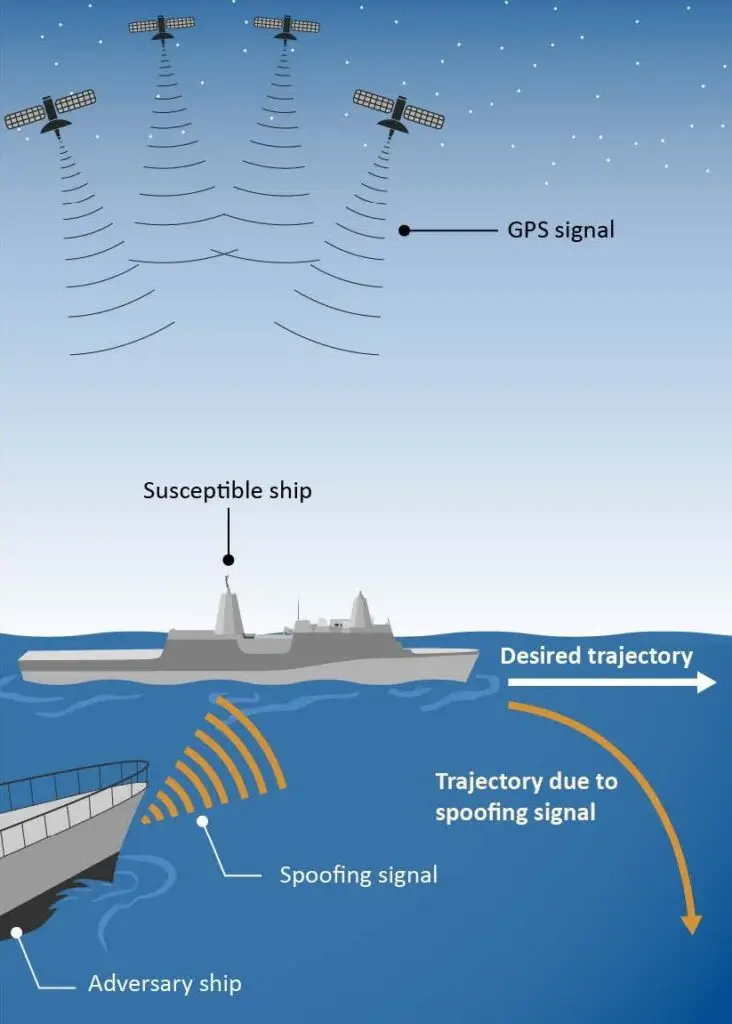
GNSS spoofing is a malicious technique that involves broadcasting fake GNSS signals to deceive receivers, leading them to calculate incorrect positioning, navigation, and timing data.
What is GNSS Spoofing?
GNSS spoofing refers to the deliberate transmission of counterfeit signals that mimic legitimate GNSS signals. This technique is used to mislead GNSS receivers into reporting false location data. Unlike GPS jamming, which blocks legitimate signals, spoofing feeds incorrect coordinates, causing navigation systems to misinterpret the actual location of the receiver.
How Does It Work?
- Signal Generation: An attacker generates fake GNSS signals that closely resemble genuine signals from GNSS satellites. These counterfeit signals are structured to confuse the receiver.
- Gradual Manipulation: The attacker may start by broadcasting signals synchronized with genuine signals and then gradually increase the power of the counterfeit signals while decreasing the power of the genuine ones. This method, known as a carry-off attack, makes it difficult for the receiver to detect the spoofing.
- Deceptive Positioning: As a result, the receiver calculates its position based on the false signals, which can lead to significant navigation errors. For example, an aircraft might believe it is flying over one location when it is actually over another.
Implications of GNSS Spoofing
- Safety Risks: In aviation, spoofing can lead to dangerous situations, such as incorrect terrain warnings or misdirected flight paths. Recent incidents in Delhi have shown how spoofing can disrupt flight operations, causing diversions and delays.
- Security Concerns: Spoofing is increasingly used in modern warfare, posing threats to military operations and civilian navigation systems alike. It has been reported in conflict zones and sensitive border areas.
- Economic Impact: The reliance on GNSS for navigation in shipping and logistics means that spoofing can have significant economic consequences, potentially leading to navigation accidents and financial losses.
Countermeasures
To mitigate the risks associated with GNSS spoofing, several strategies can be employed:
- Use of Multiple Systems: Relying on multiple navigation systems (e.g., combining GNSS with inertial navigation systems) can help reduce vulnerability to spoofing attacks.
- Differential GPS (DGPS): This technique uses a network of ground stations to correct satellite errors and improve positioning accuracy, making it harder for spoofing to go undetected.
- Signal Authentication: Developing methods to authenticate GNSS signals can help receivers distinguish between genuine and spoofed signals.
In summary, GNSS spoofing is a sophisticated threat that can have serious implications for navigation safety and security. Understanding how it works and implementing effective countermeasures is crucial for mitigating its risks.